
Sisters of the Sun Dreamtime Story
The Djanggawul (Djang’kawu) Cycle in Arnhem Land Art
Language Group: Yolŋu Matha
Moiety: Dhuwa
Clan: Rirratjingu
Region: North-East Arnhem Land, Northern Territory, centred on Yalangbara (Port Bradshaw peninsula), Northern Territory, Australia
Primary Themes:
- Journey from Burralku (spirit world) guided by the Morning Star
- Creation of the land, including dunes, waterholes, and sacred trees
- Birth of the first people and formation of clans and languages
- Fertility and life, with water and women as sources of creation
- Naming of animals, plants, and places as part of creation
- Transformation of ancestral objects into features of the landscape
- Passing on law, ceremony, and identity through story and place
The dreamtime story of the sisters of the sun and Djang’kawu cycle is one of the central creation narratives of north-east Arnhem Land, belonging to Yolŋu peoples of the Dhuwa moiety, particularly the Rirratjingu and related clans. More than a story, it is a living system of law, identity, and connection to country.
In the ancestral time, Walu, the Sun Woman, brought light and life to a dark world, while Barnumbirr, the Morning Star, guided movement and ceremony. From Burralku, the island of the dead, the Djang’kawu siblings—a brother and two sisters—journeyed to Yalangbara, a place of profound significance. Carrying sacred rangga (ceremonial objects), they transformed the land as they travelled. When placed into the earth, these objects became waterholes, plants, sand dunes, and ecological systems, establishing the landscape itself.
At Yalangbara, the sisters gave birth to the first people, forming clans and kinship structures. The Djang’kawu created freshwater springs, food sources, and named animals and places, embedding law (rom) into the land. Their actions established boundaries, systems of exchange, and social order.
A key theme is the balance of knowledge: women hold life-giving and esoteric power, while men perform certain ceremonial roles. This dual authority remains central to Yolŋu society.
Today, the Djang’kawu cycle lives on through ceremony, song, and bark painting, where designs are not illustrations, but expressions of ancestral law and presence.
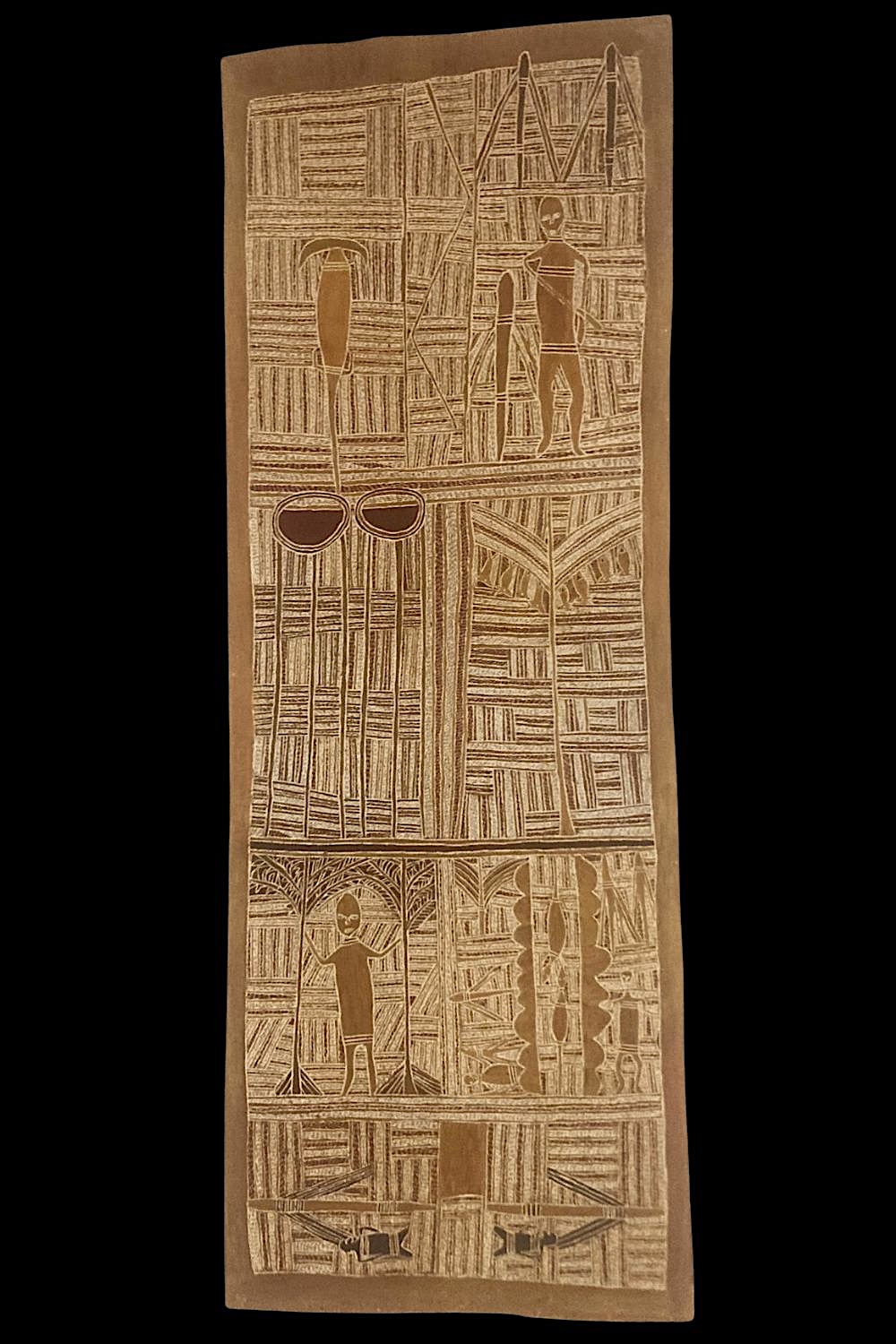
Dreamtime Story Sisters of the Sun
In the first time, when the Dreaming began, the land was silent and without shape. No birds called across the sky, no water moved through the mangrove creeks, and no wind stirred the tall grasses. The earth and sky were joined in darkness. Beneath the ground, deep in a hidden place, Walu, the Sun Woman, lay sleeping with her face folded into her arms.
At last she rose. As she lifted her arms, light spread across the world, the first dawn and then she climbed into the sky, and wherever she travelled, warmth followed her. The earth responded. Grasses pushed through sandy soils, paperbark and eucalyptus took root, and colour returned to the land. Tides began to move along the coast, and life stirred in the lagoons and tidal flats.
Spirit beings came into this new light and moved across the country, shaping it. They formed the escarpments and floodplains, the rivers, billabongs, and coastal inlets. They brought forth fish into the saltwater and animals into the bush. Among them were Barnumbir, the god of the Morning Star, rising softly above the horizon.
Then, from far across the sea came the Djanggawul: a brother, Ganjudingu, and his two sisters. They travelled in a bark canoe across open water and came ashore on the spirit island of Bralgu. They carried sacred objects and the beginnings of ceremony.
The sisters held the greatest power. They carried the totems and knew the songs that called life into the land—the rhythms of rain, the growth of yam and lily, the movement of fish through estuaries. They kept this knowledge carefully and shared it only among women. Their brother Ganjudingu watched them closely. He saw the power they held and longed for it, but each time he asked, they refused him.
Each night, Walu returned from her journey across the sky and lay beside him, and in her warmth he found comfort. But when she rose again at dawn and crossed the sky, the land seemed wide and empty. The heat shimmered, and his thoughts grew restless. In time, his longing overcame him. He turned toward his sister with longing desire. She knew the danger and felt it in the stillness between them, but she did not refuse him. What followed did not happen only once—it continued quietly, hidden like water beneath reeds.
Walu saw. From her path across the sky she watched the country and read the signs. She saw the closeness between them and the change in her husbands sister’s body. When she returned one night, she turned away from him. “You have been unfaithful,” she said. “You cannot remain here.” Her judgement was final, and the three Djanggawul were driven from the spirit island of Bralgu.
They took their canoe and crossed the sea, moving past reefs and islands until they reached the mainland of Australia at Yalangbara, where freshwater seeps through the sand and dunes rise behind the shore. Exhausted, they pulled the canoe onto the beach and slept. At dawn, cockatoos cried across the sky, and they rose again, leaving the shore to walk inland.
Ganjudingu walked ahead, his path steady, while his sisters followed. Wherever they travelled, the land responded. They struck the earth with digging sticks and fresh water rose to meet them, forming springs and waterholes. Djuda trees grew where they rested, their branches spreading wide to cast shade across the heat-hardened ground. They were no longer simply moving across the country—they were shaping it, fixing it into form.
The sisters needed to give birth to the babies they carried within them, and the journey became heavier beneath the sun. The land stretched wide—open woodland, grass plains, and distant rises shimmering in the heat. When Bildjiwuraroiju could go no further, they stopped. There was no shelter but the sky. Miralaidj struck the ground, and water rose; she struck again, and a tree grew, its shade falling across the earth. Beneath that shelter, the children were born. In this way, the first people came into the Arnhemland world, and the land held that moment within it.
As the children grew, they spread across the country—along rivers, through forest, across floodplains rich with fish and birdlife. Camps formed, and people lived from the land, taking what they needed. But with growth came conflict. Groups began to claim places—the best fishing waters, the richest hunting grounds, the yam fields that returned each season. Voices rose, and spears were lifted.
Ganjudingu now impossibly old saw this and felt unease settle within him. “This is not good,” he said. Together, the Djanggawul walked among their people and gave them law. They showed each group where they belonged, where they could hunt, where they must not go, and how to live with one another. Boundaries were set, and balance slowly returned to the land.
Yet still the sisters held their sacred knowledge apart. They gathered in ceremony, their songs moving through the trees and across the water. Ganjudingu listened from a distance, and the old desire returned, stronger now. He wanted the power they held—not only for himself, but for the men. One night he tried to take the sacred objects by force, but the sisters woke and stopped him.
Later, when the sisters moved through the bush gathering food—digging for yams beneath soft earth and walking through stands of pandanus and stringybark—men followed them unseen. They had watched, waited, and learned. When the moment came, they took the sacred totems and fled.
The sisters felt the loss immediately, as though something had been torn from the country itself. They followed the tracks through broken grass and disturbed soil, moving quickly, but when they drew near they heard the sound of ceremony. The men had already begun and centre among them stood Ganjudingu.
The power had changed hands.
Grief came first, deep and heavy, like a storm settling over the land. But then Bildjiwuraroiju spoke, her voice steady. “What has been taken cannot be returned,” she said. “But there is greater power still.” She placed her hand upon her body. “We give life. From us all people come. That cannot be taken. And the songs remain with us.” Slowly, the meaning settled between them. The men would hold the totems and perform the ceremonies. The women would hold life and the deeper knowledge that could not be lost.
And so the balance of the world was remade—not through harmony, but through loss, change, and acceptance. From that time onward, the roles were set, and across the coasts, rivers, and plains of Arnhem Land, the story remains—held in the land itself, carried in ceremony, and remembered by those who belong to it.
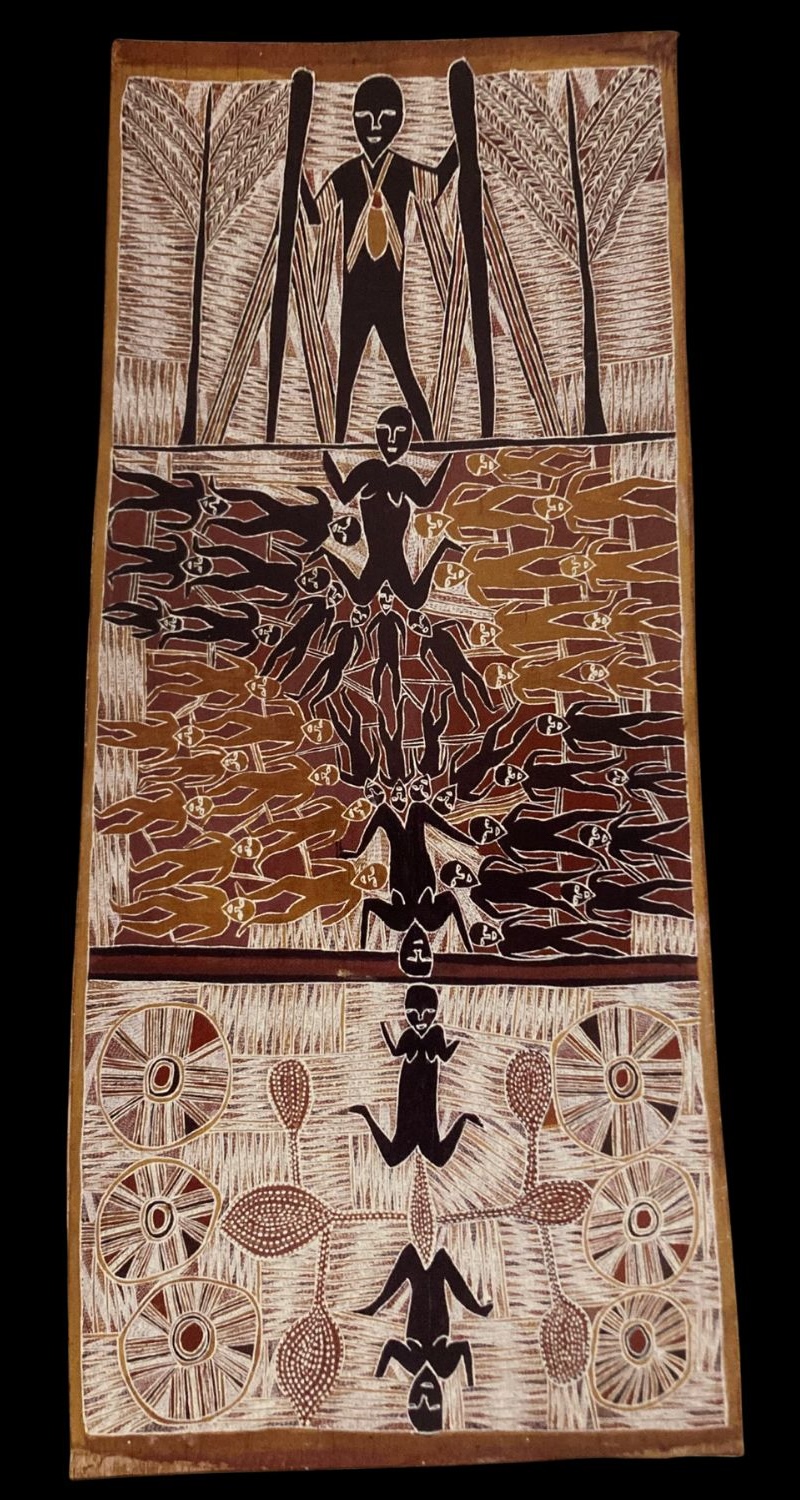
Painted Dreamtime stories in Yirrkala Art
The Birth of the Children of Yalangbara
This bark painting is organised in three registers, a classical Yolŋu narrative structure that unfolds the sacred events of Yalangbara, one of the most significant ancestral sites in North-East Arnhem Land. Each panel operates as both a discrete moment and part of a continuous cosmology.
In the upper register, the Djang’kawu Brother, Gunbulapula, stands in a commanding, frontal pose. His elongated form reflects Madayin (sacred law) authority. He holds the mawalan (digging sticks), not merely as tools but as generative instruments of creation, from which the flanking casuarina (diota) trees have emerged. The lorikeet feather tassels signify ceremony and spiritual potency. This panel marks the ancestral arrival and the transformation of land into law.
The central panel depicts the birth of humanity. Figures radiate outward in a dynamic, almost centrifugal composition, expressing multiplication and the emergence of distinct clan groups. Yellow figures represent females—associated with fertility and protection—while darker male figures signify endurance, having been “hardened” by exposure. This is not simply a scene of birth, but a visual mapping of kinship, language, and social order.
In the lower register, interconnected oval forms represent afterbirth, symbolising continuity between people and land. The surrounding circular motifs depict conical mats, used to shield female children, embodying both physical protection and the restriction of sacred knowledge. The vertical alignment reinforces ancestral descent into the present.
The rarrk (cross-hatching) unifies the composition, signifying both wanga (country) and the pain of childbirth—an assertion that land, body, and creation are inseparable.
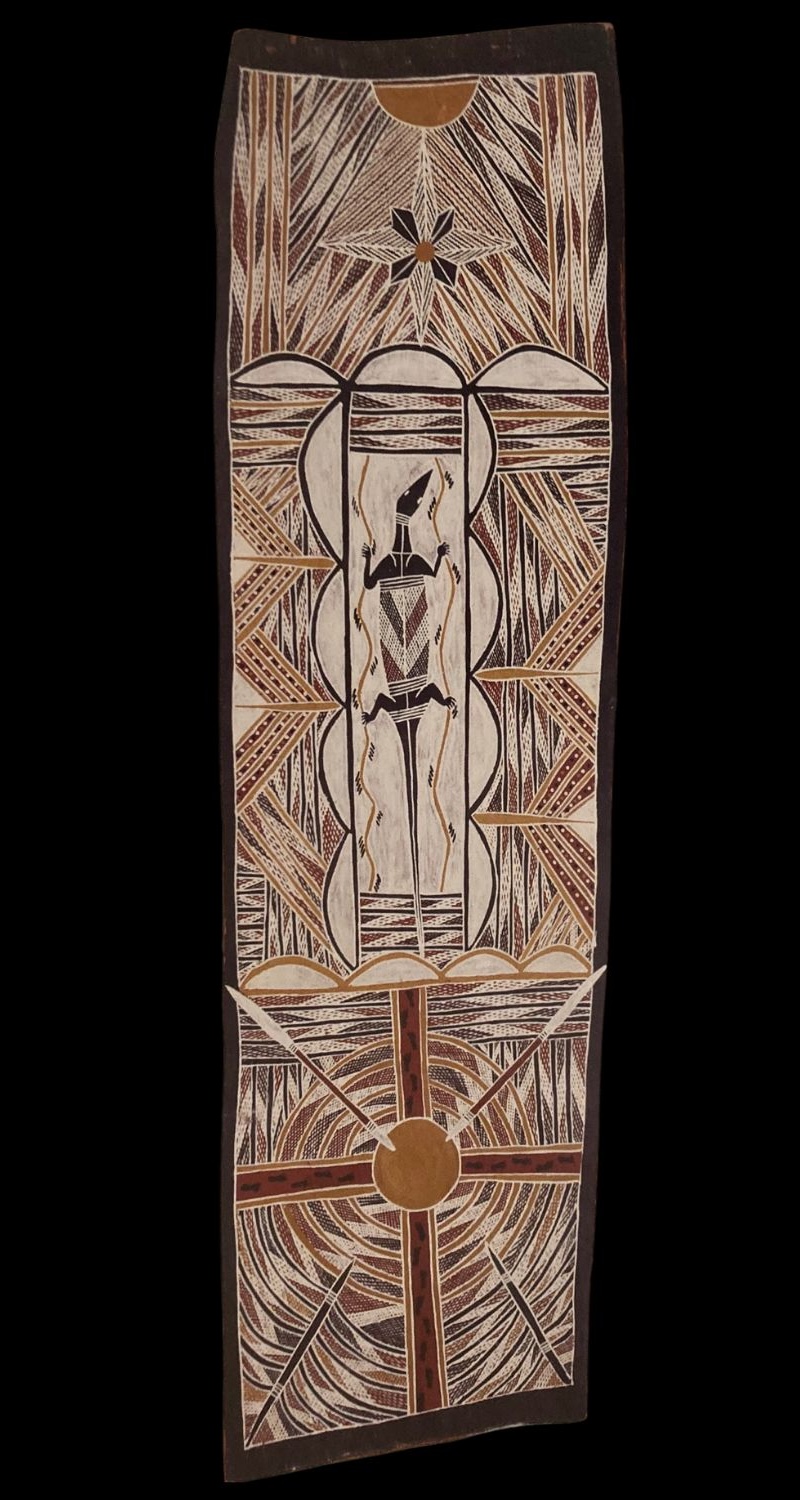
This bark painting presents a vertical narrative of the Djang’kawu ancestral journey to Yalangbara, structured as a unified cosmological map rather than discrete panels. It recounts their arrival from Burralku, guided by Banumbirr, the Morning Star, depicted at the apex with radiating light that signals both dawn and spiritual orientation.
Below, the rising sun’s rays spread across the composition, illuminating the sacred landscape of Yalangbara. The white semicircular forms represent the sand dunes the Djang’kawu climbed after disembarking from their canoe, carrying their sacred objects. Within the central field appears the goanna, djanda, shown averting its gaze from the brilliance of the rising sun, its tracks marking movement across newly formed country. This central section also signifies Balma, the sacred area beyond the dunes where the Djang’kawu gave birth, establishing the origins of clan identity.
The composition resolves in the lower register with the circular motif of milngurr, the freshwater springs created by the Djang’kawu using their mawalan (digging sticks). Radiating lines and directional forms indicate footprints moving toward and away from this site, emphasising its role as a generative centre. These waters are understood as reservoirs of Rirratjingu souls, and more broadly as sources of fertility, knowledge, and learning.
The paddles near the upper section refer to the creation of underwater milngurr in the sea, while the darker forms below denote the mawalan used to create freshwater sources on land. Throughout, the rarrk binds land, water, and ancestral action into a single continuum, affirming Yalangbara as a place where creation, knowledge, and life itself originate.
Artwork by Mawalan Marika
All images in this article are for educational purposes only.
This site may contain copyrighted material the use of which was not specified by the copyright owner.