Aboriginal Pearl Shell
– A Collector’s Guide to an Exceptional Art Form
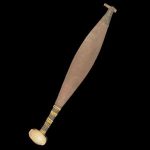
The Aboriginal pearl shell is one of the most striking and symbolically charged forms of adornment and artifacts produced by Aboriginal artists of Western Australia and the Central Desert. More than a utilitarian object or a decorative ornament, the Aboriginal pearl shell—known as Riji or Jakoli in the Kimberley and Lonka Lonka in Central Australia—embodies deep cultural meaning, trade history, artistic refinement, and ceremonial power. For collectors searching for Aboriginal pearl shell examples of quality, understanding age, carving style, provenance, and regional variation is essential.
Historically, the Aboriginal pearl shell was suspended from a human-hair belt and worn as a pubic covering by initiated men. While not secret or restricted, its symbolic meanings often were, and could vary depending on an individual’s initiation level. This article focuses on carved and engraved examples—the highly prized works known as Riji, Jakoli, or Lonka Lonka—rather than plain, undecorated Guwan shells.
Origins and Early Records
Pearl shell has been in continuous use across Aboriginal Australia for centuries, and was documented as early as 1818. The French explorer Freycinet noted in Shark Bay: “An old man… distinguished from the rest by a shell hanging from his girdle.” This is one of the earliest European descriptions of what we now recognise as a classic Aboriginal pearl shell ornament.
They are an original and unique form of Aboriginal Art. I buy Aboriginal Pearl shell. If you have one you would like to sell please contact me
The ultimate reference book for this unique form of Aboriginal art is a book called Riji and Jakoli. Kim Akerman and John Stanton
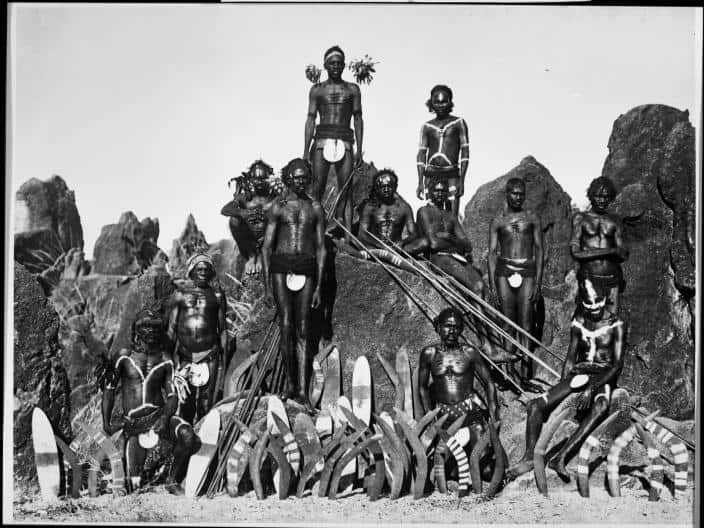
Aboriginal Bardi men wearing pearl shell groin covers with boomerangs and shields.
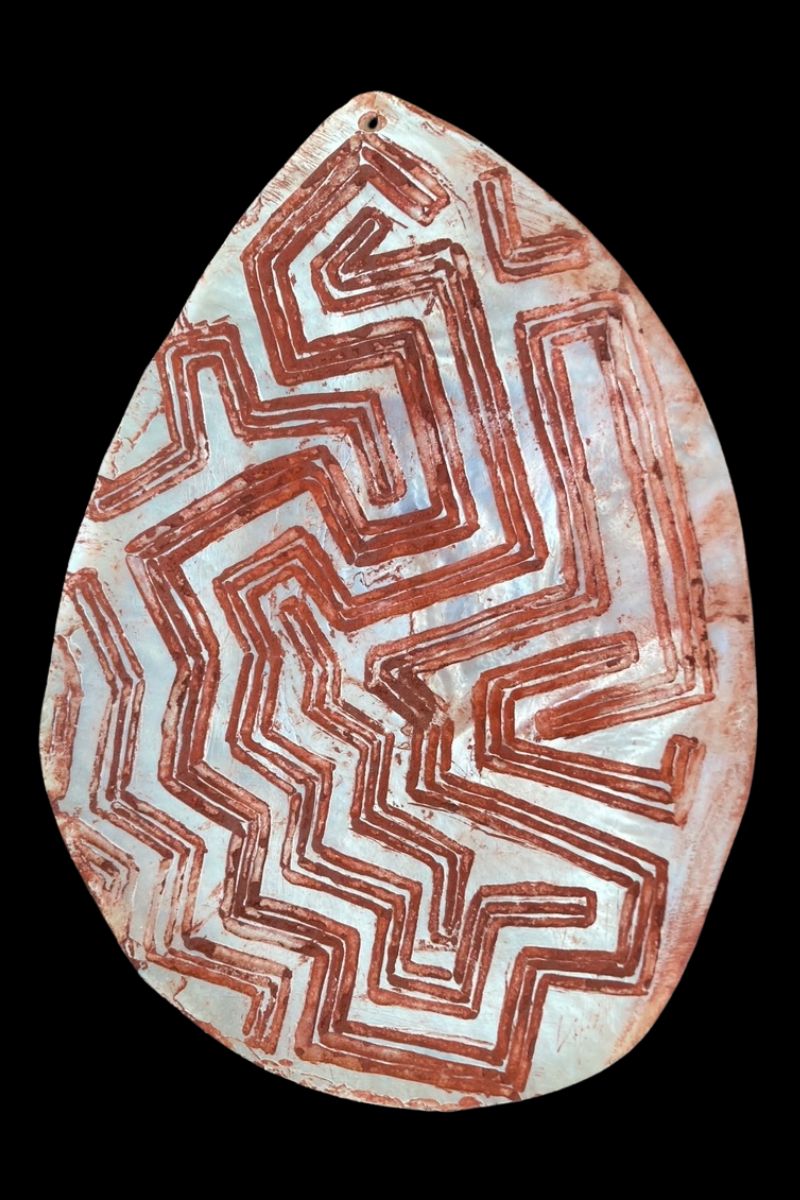
Artistic Tradition and Carving Styles
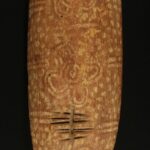
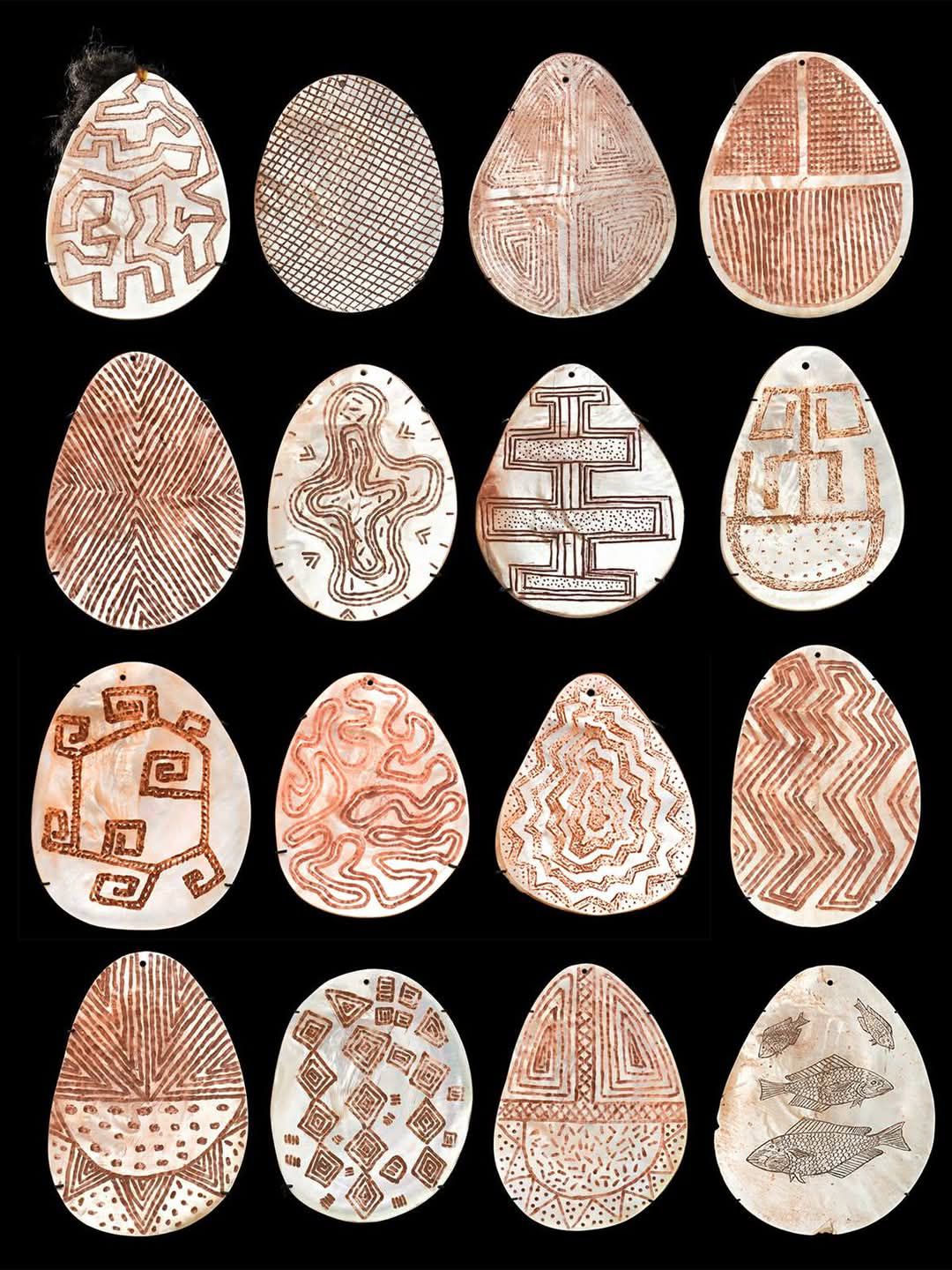
The carved designs on an Aboriginal pearl shell are among the most important indicators of age and authenticity. Older, nineteenth-century shells typically feature La Grange–style engravings—geometric, powerful, and deeply incised—closely related to the motif traditions found on Kimberley spear throwers and shields. These early pieces required extensive preparation: the adductor scar was laboriously removed to create a clean surface for incision. This time-consuming process is one of the easier ways to tell if a shell was made with the intent of being used in ceremony or made for sale.
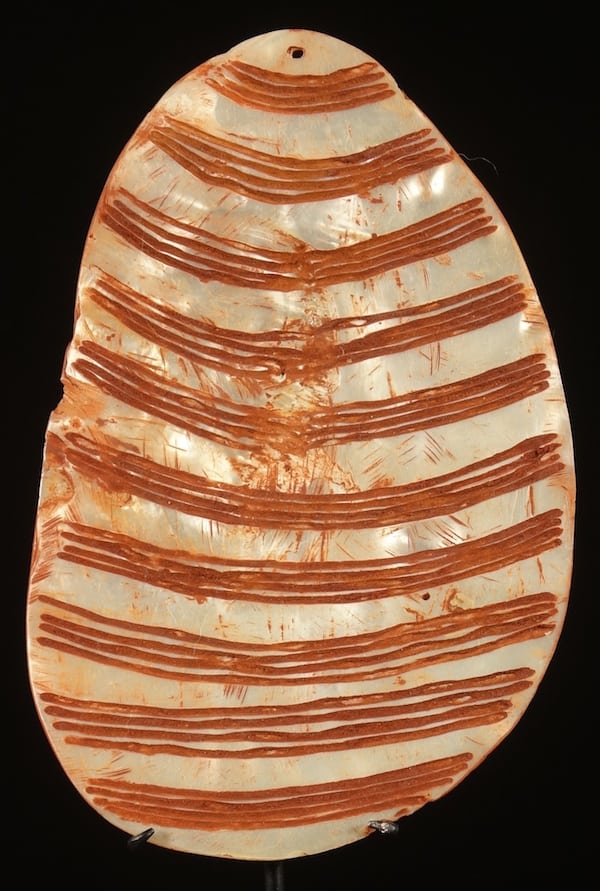
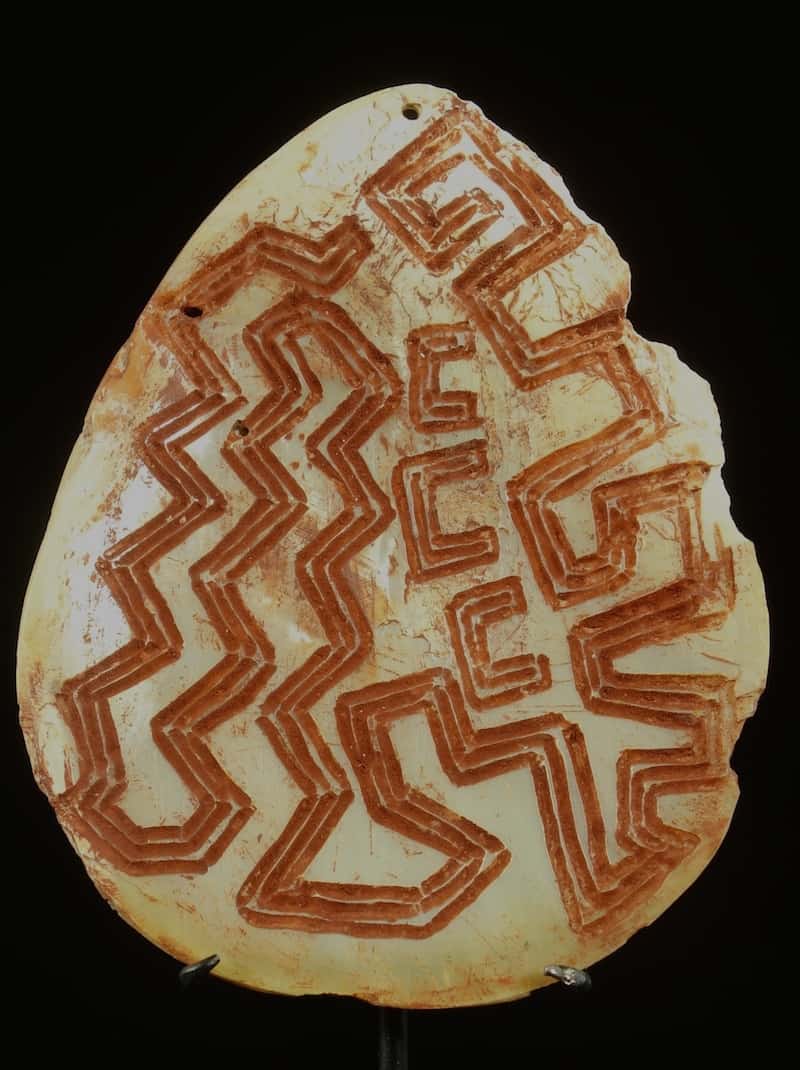
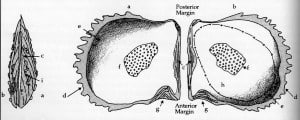
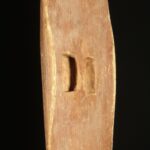
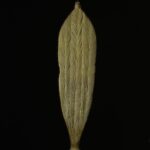
Aboriginal Pearl Shell Adductor Scar
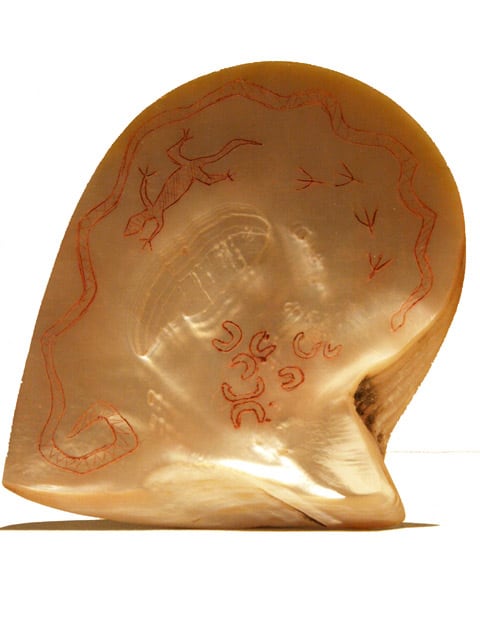
By contrast, more recent Aboriginal pearl shells often retain their adductor scar, and their designs may be symmetrical or more scratchy and less precise—an indication of more recent manufacture. Early shells typically have grooves around 1–2 mm wide, executed with great confidence and forming crisp right angles. Rounded incisions or overly fine or shallow lines can indicate recent production or even fakes.
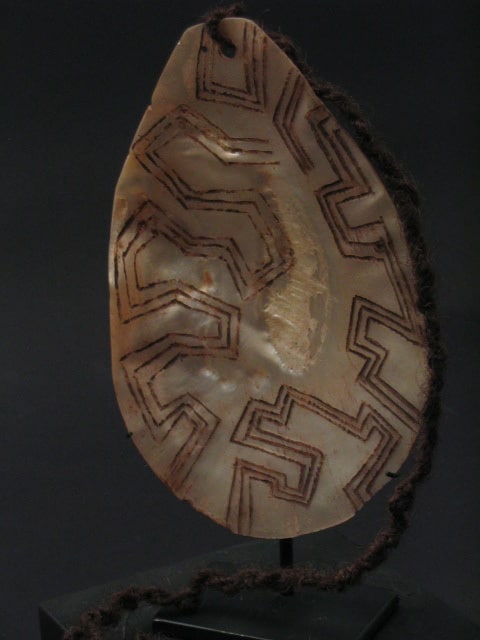
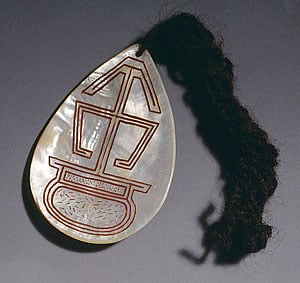
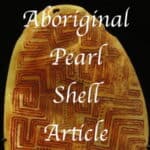
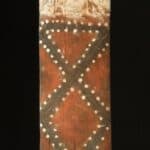
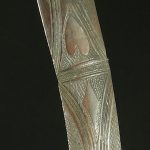
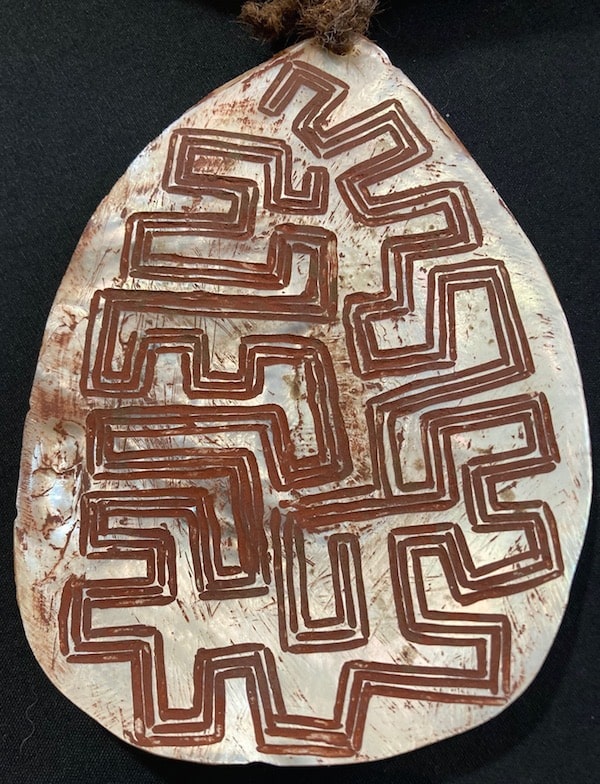
Aboriginal pearl Shell Design
I think it is great that Aboriginal Art is still made by Aboriginal Artists but it is nice to have the knowledge to tell old from new.
Contemporary pieces like that opposite are often made with symmetrical shallower designs.
Note that the hair string is not a good indicator of age.
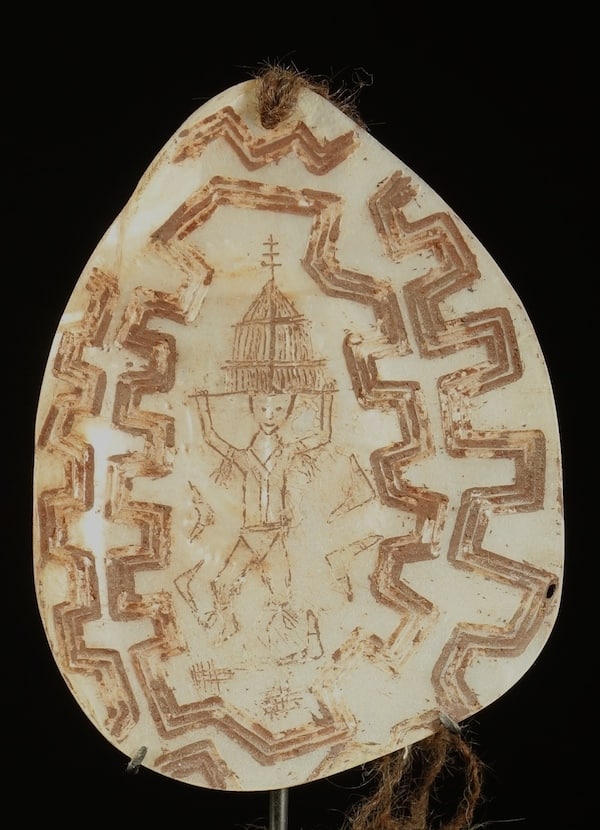
Some transitional pearlshells are still highly collectable especially those that are by a known artist or have high artistic merit
Suspension Holes and Construction
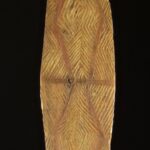
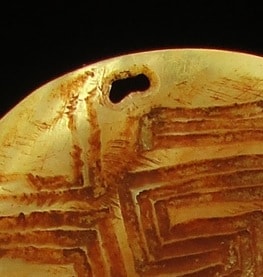
Another key diagnostic feature for the collector is the method of piercing. Historically, Aboriginal artists drilled the suspension hole using stone or metal tools from each side, often resulting in slight misalignment. Some older Riji or Jakoli were not drilled at all; instead, the attachment was achieved using resin. A rare and desirable technique involved sawing two perpendicular grooves—one on the front, one on the reverse—allowing the hole to emerge at their intersection.
Modern examples tend to be pierced with a single, clean drill hole made by electric tools, typically larger and perfectly round.
Fake Aboriginal pearl Shell
Fake aboriginal pearl shells are often carved onto old pieces of pearl shell. Old Jakoli, lonka lonka were a prized possession of Western Australian Aborigines and made from new pieces of pristine shell.
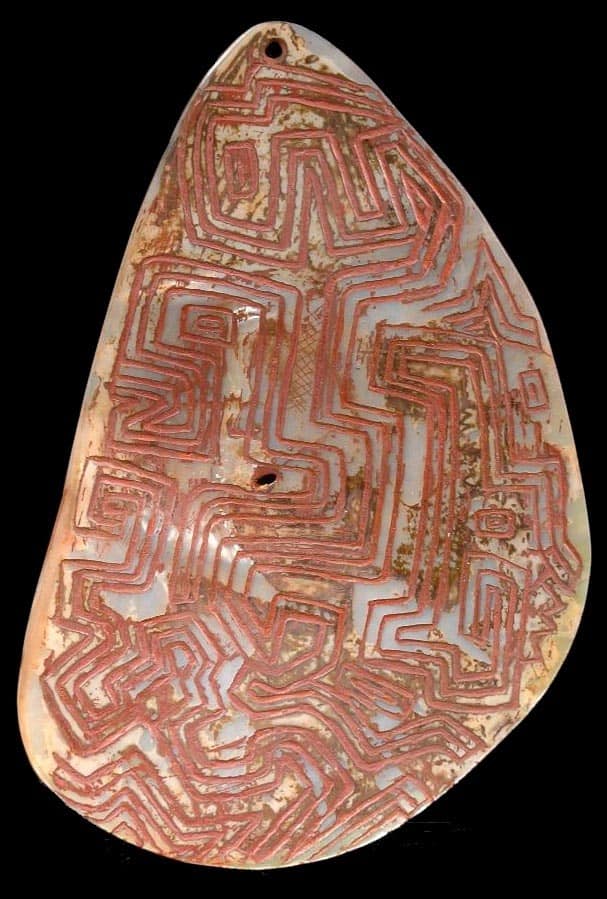
Grooves on fakes are not as uniform as on early aboriginal pearl shells.
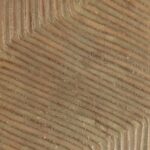
The grooves on almost all the old pearl shells are about 1-2mm wide. When the grooves get really fine like this I would need to see it in person or not buy it.
The incised design should have strong right angles and not rounded corners.
Aboriginal Pearl Shell as Trade and Ceremony
The Aboriginal pearl shell was one of the most important long-distance trade items in Aboriginal Australia. Originating along the North-West coast of Western Australia, pearl shells travelled inland along established trade routes as far as Alice Springs, Boulia in Queensland, Kalgoorlie, and Yalata. In arid regions, the shell’s shimmering surface was associated with water, rain, and the Rainbow Serpent. Rainmakers sometimes bit fragments from the shell to activate its spiritual potency during ceremonies.
While used in ritual contexts, their most common role was as personal adornments worn by initiated men—objects of great pride and cultural identity.
Collecting Aboriginal Pearl Shell
As with all Aboriginal art, there is ordinary and extraordinary. For every twenty Aboriginal pearl shells that surface on the market, only one stands out for its engraving quality, age, patina, and cultural resonance. These exceptional examples are the most sought-after by collectors of Aboriginal art.
If you have an Aboriginal pearl shell—Riji, Jakoli, or Lonka Lonka—that you wish to sell, I am always interested in acquiring high-quality pieces.
The definitive reference for this artform remains Riji and Jakoli by Kim Akerman and John Stanton, upon which this article draws extensively.
The Aboriginal pearl shell remains one of the most beautiful, symbolically rich, and culturally significant forms of Aboriginal art—an enduring intersection of adornment, ceremony, trade, and artistic mastery.
All images in this article are for educational purposes only.
This site may contain copyrighted material the use of which was not specified by the copyright owner.
Recommended reading
Scales of the Serpent – Kimberley pearl Shell in Aboriginal Australia
Aboriginal Weapons and Artifacts