
The Lumah Lumah Dream time Story
The Lumah Lumah narrative (sometimes spelled luma luma) stands as one of the most significant ceremonial cycles of the Gunwinggu people of western Arnhem Land, performed within initiation rites and conveying a profound moral framework concerning the consequences of transgression and the proper use of power.
Lumah Lumah, a powerful and enigmatic giant, is said to have arrived from an unknown place, bringing with him sacred knowledge, ceremonial practices, unique weapons and totemic objects. He instructed the people in ceremonial songs and dances that promised prosperity, health, and abundance, yet insisted that these ceremonies could only be performed under his authority. Over time, this authority became oppressive. Luma Luma abused his position—taking women from their husbands, consuming the best food, and being a tyrant within the community.
Unable to confront him directly, a group of men began to conduct the ceremonies in secret. When Luma Luma discovered this, he demonstrated his supernatural power by transforming their carved totems into living animals. Despite this display, the balance had shifted. When it became known that Luma Luma had killed, cooked, and eaten the wife of a clan leader, the men united in opposition.
They devised a plan, preparing a small cooking fire on an open stretch of beach to have the smell lure the greedy giant into the open. There, they surrounded and speared him. The depiction opposite captures this scene.
As he lay dying, Lumah Lumah offered to reveal his final and most sacred knowledge. He imparted important ceremonial teachings and presented a carved figure of the Rainbow Serpent, symbolising ultimate ancestral power. In the version, as recounted by Dick Murrumurru, Lumah Lumah was killed and then his body burnt upon a great fire.

Lumah Lumah being speared by Dick Murrumurru.

Lumah Lumah with dilly bags by Yirawala
Importance of lumah Lumah
The Luma Luma story explains the origins of sacred ceremonies, totems, and ancestral knowledge, while reinforcing a central principle of Aboriginal law: that power must be exercised within its proper bounds, and that imbalance invites consequence.
This account need not be understood as beyond rational interpretation. Elements within the Luma Luma narrative invite comparison with known patterns of cultural contact and seafaring across northern Australia. The presence of canoes in rock art, for example, demonstrates that long-distance voyaging—sometimes involuntary—was entirely possible, with vessels capable of being driven vast distances off course by prevailing winds and currents.
Certain descriptive features attributed to Luma Luma also resonate with material culture and practices from regions to the north and east. The suggestion of marked or patterned skin may be read in light of tattooing traditions widely documented in Melanesia. Likewise, the reference to a knobbed club finds parallels in weapon forms associated with the Torres Strait and the Papuan Gulf. Even the more confronting aspects of the narrative—such as the consumption of human flesh—align with practices historically recorded in many parts of Melanesia, suggesting that such details may reflect observed behaviours rather than purely symbolic invention.
From this perspective, Luma Luma may be interpreted not solely as a mythic being, but as a cultural memory of contact: a traveller, perhaps driven off course, arriving from further east and introducing unfamiliar objects, rituals, and authority structures. As with many Aboriginal narratives, the account operates simultaneously on multiple levels—cosmological, moral, and historical—preserving within its structure both ancestral law and the possibility of lived encounter.
The following Dreamtime story is as recorded by Louis A Allen in the book Time Before Morning
At intervals, often years apart, Aborigines from many different groups gather at well-marked locations to conduct sacred ceremonies that celebrate the lives and deeds of their ancestral heroes. Often the bodies of the men are painted in distinctive designs to represent mythical figures.
The Luma Luma myth is one of the most important ceremonial cycles of the Gunwinggu tribe in western Arnhem Land. It is a feature of the age-grading rites that are conducted to initiate the boys into manhood. As the myth is sung and danced, it emphasizes the lesson all must remember: that adultery brings evil in its train.
LUMA LUMA was a giant who came long ago from the place of the mists, bringing with him many wives and children.
When the sun burns hot overhead, the people sit in the shade of the palm trees and speak of Luma Luma. They tell of the long spears he carried and the knobbed club which he kept always close to hand, ready to break the heads of those who opposed him. They say that he belonged also to the sea and that at times his huge body could be seen surging through the waves in the form of a whale, accompanied by the barramundi fish, who was his constant companion.
At night, when the camp-fire embers die down and the shadows hide their faces, the people retell the tales they have heard from their fathers: of the children Luma Luma lured from their mothers, then killed with his club and roasted over his camp fire; of the women he took from their husbands and lay with openly in camp. They tell also of the great snake that made its way through the bush after Luma Luma, and at night shared his bed. And here the voices of the people die and they stare into the fire, for some things must not be spoken .
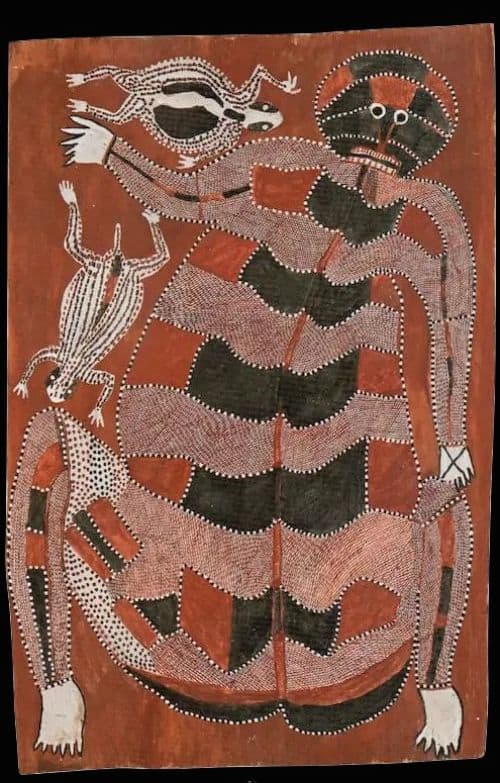
Luma Luma as depicted by Peter Marralwanga with from totems
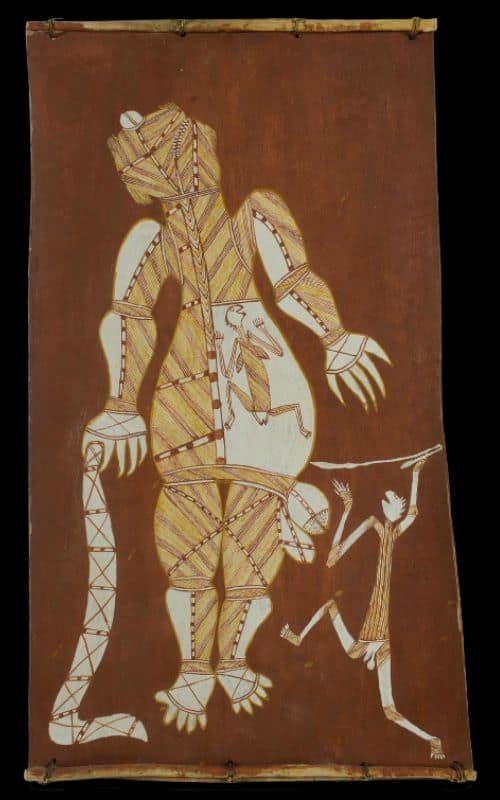
Lumah Lumah with the clans cooked and eaten wife depicted as being in Lamah Lumah’s belly by Dick Murramurra
When Luma Luma first came to the Gunwinggu country long, long ago, in the Dreamtime, none knew from what land he came, or whether from the sea. He came through the heat haze, his massive form clearing a path through the grass for his wives and children, who walked in a file behind him.
The people accosted the strangers, but when the giant with the great club showed he had no fear of them, they let him pass. They saw that he carried a spear-thrower and many long spears, as well as his club, and that over his shoulder hung a net bag in which were many sacred totems—carved figures of the barramundi fish, the mackerel, and the goanna.
Luma Luma and his family camped at a place where there were many Gunwinggu people. At once, Luma Luma went to the men and made known his special powers.
“I shall teach you songs and dances that will bring favour from the totemic spirits,” he told them. “If you perform the ceremonies as I show you, the game shall increase, you shall have many children, sickness shall not visit you, and you shall be happy.”
So the people obeyed Luma Luma and sang and danced only when he was present with the totems to lead them. Time passed, and Luma Luma became interested in the wife of one of the men. “Come to the grassy place by the lagoon and lie with me,” he urged her. But the woman repulsed him, and this angered him greatly.
“You shall yet do as I bid,” Luma Luma told her. He took her net bag that she had hung on a tree and carried it to his fire. There he held it in the smoke and sang a magic song. The wife watched and she feared greatly, for Luma Luma’s powers were well known. That evening she found the giant’s footprints where he had walked in the soft ground from the camp to the lagoon.
Luma Luma’s magic reached out to her; she placed her feet in his prints, stretching to match his giant stride as she followed his path. When Luma Luma returned, he saw the footprints and knew the woman had given in. That night her husband slept alone; the people heard as he beat his fist on the ground in his rage and fear.
Now each time the men went fishing or hunting, Luma Luma would seduce one of their wives. When the men returned, Luma Luma brought out the sacred totems and danced and sang the power ceremonies. So the men were afraid to confront him.
Soon some of the men began to plot against Luma Luma. “We will go to a secret place, where we will call upon the spirits to help us get rid of Luma Luma,” they said. So the men went to a distant water hole and made a camp fire. They carved totemic figures and began to sing power songs, calling upon the spirits of the mackerel, the barramundi, and the goanna to help them overcome Luma Luma.
The giant was hunting when he saw smoke rising. He was surprised, for it was the middle of the day when camp fires were rarely lit. Luma Luma walked cautiously through the heavy grass until he came to the clearing from which the smoke rose. Here several men were conducting a sacred ceremony. Luma Luma watched. They were dancing his dances and singing his songs, holding totemic figures they had carved themselves.
Shouting with anger, Luma Luma leapt out of the bush, waving his spears. “You are not performing the dance properly,” he roared. “The spirits will be angered and will destroy us all.”
Surprised and frightened, the men tried to run away, carrying with them the sacred totems. But on one side Luma Luma and his spears blocked their way; on the other side was impassable bush. In their fright, the men jumped into the water hole and began to swim across. The sacred totems broke free and floated on the water.
Luma Luma saw the men were now beyond his reach. He was determined they should not keep the totems, so he threw a spear at the nearest object, a wooden mackerel totem, and called out its secret name as he did so. The totem turned into a mackerel and swam off. Luma Luma threw his two remaining spears at the barramundi and the goanna totems, and they, too, came to life and disappeared. Seeing this, the men feared Luma Luma’s power even more. They climbed out of the pool and ran back to the camp to tell what had happened.
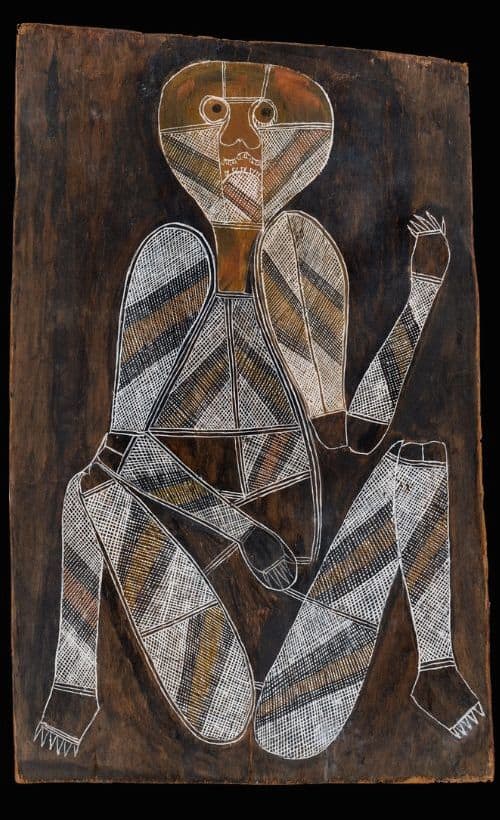
Lumah Lumah as depicted by Bobby Ngainjmirra

Lumah Lumah as depicted by January Nanganyari
Now some of the men still plotted together, and they laid a trap for Luma Luma. They chose an open space by the sea, where Luma Luma could come upon them only from one direction. Here they lit a fire and placed green twigs on the blaze so a light smoke would be visible. Then they covered their spears with sand and began to dance on the beach, each man dancing back and forth over his spears.
Luma Luma saw the smoke and soon came storming into the clearing. But the men were ready. At once, each grasped his spear between his toes and lifted it to his hand.
The spears flew. Thunk. Thunk. Thunk. Again and again they threw. The stone points drove home until the green parrot feathers at their bases disappeared into the giant’s flesh. The spears pierced his shoulders. They lodged in his belly. They stuck out from his arms.
Luma Luma tried to fight back, but he was weakened from the blood that gushed onto the sand.
“Don’t throw any more,” he said. “Let me live a little longer and I will give you the sacred totems. I will teach you the secret power words so that you will be able to call upon the spirits to help you. Then, when I am gone, you will remember my name with honour.”
So they let Luma Luma live and he showed them the most secret mysteries. He taught them invocations and sacred names they had never heard before. From its hiding place in the bush, he brought forth a carved figure of the Rainbow Snake, wrapped in paperbark.
He poured water on the fire so that a cloud of steam arose. Then he held the sacred object in the steam and told them: “I purify this totem, for it is the strongest and most sacred. It will watch over you and cause your numbers to increase and prosper.”
The Sun Woman was drawing close to the horizon when the end of the ceremonies neared. Across the water her beams made a path of light.
“This is the last ceremony,” said Luma Luma. “When I am gone, you shall dance it to commemorate my death. Both men and women shall dance it.”
After he had shown them the final dance, Luma Luma walked down the sand and into the water. When they saw this, the people gathered on the beach. As they watched, a barramundi leaped from the sun path and fell back into the water with a splash. Luma Luma walked far out. The water reached his chin. It reached his eyes. It covered his head. Where he disappeared, a whale surfaced. It spouted water into the air, then swam down the sun path and followed the barramundi toward the deep waters.
“Luma Luma has become the whale,” the people said. “The barramundi swims with him in the sun path and is his companion. Both shall always be sacred totems to us. And so it has been.”
It is entirely possible that what appear as different versions are, in fact, expressions of the same underlying narrative, revealed at different levels of knowledge. Within Aboriginal cultural systems, stories are rarely singular or fixed; they are layered, with deeper meanings and details disclosed according to initiation, authority, and custodianship.
As for the suggestion that Luma Luma’s remains might exist,ochred and hidden in a restricted place, this aligns with a broader principle: that some knowledge—whether physical, ceremonial, or narrative—is deliberately concealed. In Aboriginal law, what is most powerful is often what is least visible.
Mythology or History: Reconsidering the Lumah Lumah Narrative
The Luma Luma Dreaming may preserve more than a purely mythological account. It can be understood, in part, as an oral history—one that records the arrival of an unfamiliar group, possibly Melanesian, onto the shores of Gunwinggu country. This reading does not diminish its ceremonial or spiritual authority; rather, it reflects the well-established principle that Aboriginal narratives operate simultaneously as law, memory, and history.
A closer examination of the narrative reveals a series of details consistent with the behaviour of a historical individual rather than a purely supernatural being. Luma Luma arrives not alone, but with wives and children moving in formation behind him, suggesting migration or displacement rather than singular apparition . He carries a net bag containing carved totemic objects, indicating the transport of cultural material rather than spontaneous creation. The story emphasises that he teaches songs, dances, and ceremonies unfamiliar to the local people—behaviour consistent with cultural transmission following contact.
His authority is maintained through control of restricted knowledge, insisting ceremonies cannot be performed without him, a pattern typical of an outsider establishing dominance. His use of personal objects to exert influence may reflect ritual practices that appeared unfamiliar and were therefore interpreted as “magic.” Crucially, Luma Luma is physically vulnerable: he can be wounded, weakened, and ultimately killed. His negotiation for time in exchange for knowledge, and the structured transmission of that knowledge before death, align closely with human behaviour and initiation frameworks.
Further supporting this interpretation are broader cultural parallels. Rock art demonstrates that voyaging canoes travelled vast distances, sometimes driven off course toward northern Australia. Established trade networks between southern New Guinea and the Torres Strait confirm sustained maritime movement. Descriptions of Luma Luma’s marked skin align with Melanesian tattooing and scarification practices, while the knobbed club he carries closely resembles weapons from Papua New Guinea the Torres Strai and north East Queenslandt. His origin “from the east” is geographically consistent, and the carved objects he carries parallel Melanesian carving traditions. Even the description of a vessel—possibly interpreted as a whale—may reflect unfamiliar technology translated through analogy. Accounts of cannibalism further align with practices historically recorded in parts of New Guinea and the Torres Strait.
Taken together, these elements suggest that the Luma Luma narrative may encode a distant memory of contact—preserved within a ceremonial framework and shaped by cultural interpretation. As with much Aboriginal knowledge, it resists simple classification. It is both mythology and history: a narrative that explains law, authority, and identity, while retaining traces of real encounters.